Logo
Logo
ServicesIndustriesCase StudiesBlogsCareersLet's Connect
blue-white-icon
black-image
Logo
ServicesIndustriesCase StudiesBlogsCareersLet's Connect
burger-icon
hamburger
The Real Benefits of RPA in 2026: What It Still Does Well, and What Changed
Blogs/RPA Benefits

The Real Benefits of RPA in 2026: What It Still Does Well, and What Changed

December 17, 2025
Share Now

Table of Contents

  1. 1. What robotic process automation actually is
  2. 2. The benefits of RPA
  3. 3. The condition attached to every benefit on that list
  4. 4. Where RPA is the wrong answer
  5. 5. What changed in the category
  6. 6. How to get the benefits, in five steps
  7. 7. Where to start with RPA
  8. 8. Frequently asked questions

Search for the benefits of RPA and you will find the same seven items in the same order, on page after page. Efficiency. Cost. Accuracy. Compliance. Scalability. Happier staff. Happier customers.
Those benefits of RPA are real, but most of those pages were written between 2019 and 2023, and the category has moved underneath them. Robotic process automation is no longer a market of its own in the way it was, and the thing vendors now sell you is not quite the thing those pages describe.
This guide gives you both halves: what RPA genuinely does well with the condition attached to each benefit, and what changed, with dates and sources, so you can quote it without being corrected.
One more thing: you will see productivity percentages quoted everywhere on this query, and most cannot be traced to a survey you can read, so this page uses three sources you can check yourself and no invented numbers.

What robotic process automation actually is

Robotic process automation is software that works your applications the way a person does. It opens the screen, reads the field, copies the value and clicks the button, following rules somebody wrote down without deciding anything.That is the whole idea, and everything else is detail about how well it does it.

Stay Ahead With 4Labs

Get expert insights, security briefings, and the latest innovations in your inbox.

  • Afghanistan+93
  • Albania+355
  • Algeria+213
  • Andorra+376
  • Angola+244
  • Antigua and Barbuda+1268
  • Argentina+54
  • Armenia+374
  • Aruba+297
  • Australia+61
  • Austria+43
  • Azerbaijan+994
  • Bahamas+1242
  • Bahrain+973
  • Bangladesh+880
  • Barbados+1246
  • Belarus+375
  • Belgium+32
  • Belize+501
  • Benin+229
  • Bhutan+975
  • Bolivia+591
  • Bosnia and Herzegovina+387
  • Botswana+267
  • Brazil+55
  • British Indian Ocean Territory+246
  • Brunei+673
  • Bulgaria+359
  • Burkina Faso+226
  • Burundi+257
  • Cambodia+855
  • Cameroon+237
  • Canada+1
  • Cape Verde+238
  • Caribbean Netherlands+599
  • Cayman Islands+1
  • Central African Republic+236
  • Chad+235
  • Chile+56
  • China+86
  • Colombia+57
  • Comoros+269
  • Congo+243
  • Congo+242
  • Costa Rica+506
  • Côte d'Ivoire+225
  • Croatia+385
  • Cuba+53
  • Curaçao+599
  • Cyprus+357
  • Czech Republic+420
  • Denmark+45
  • Djibouti+253
  • Dominica+1767
  • Dominican Republic+1
  • Ecuador+593
  • Egypt+20
  • El Salvador+503
  • Equatorial Guinea+240
  • Eritrea+291
  • Estonia+372
  • Ethiopia+251
  • Faroe Islands+298
  • Fiji+679
  • Finland+358
  • France+33
  • French Guiana+594
  • French Polynesia+689
  • Gabon+241
  • Gambia+220
  • Georgia+995
  • Germany+49
  • Ghana+233
  • Gibraltar+350
  • Greece+30
  • Greenland+299
  • Grenada+1473
  • Guadeloupe+590
  • Guam+1671
  • Guatemala+502
  • Guinea+224
  • Guinea-Bissau+245
  • Guyana+592
  • Haiti+509
  • Honduras+504
  • Hong Kong+852
  • Hungary+36
  • Iceland+354
  • India+91
  • Indonesia+62
  • Iran+98
  • Iraq+964
  • Ireland+353
  • Israel+972
  • Italy+39
  • Jamaica+1876
  • Japan+81
  • Jordan+962
  • Kazakhstan+7
  • Kenya+254
  • Kiribati+686
  • Kosovo+383
  • Kuwait+965
  • Kyrgyzstan+996
  • Laos+856
  • Latvia+371
  • Lebanon+961
  • Lesotho+266
  • Liberia+231
  • Libya+218
  • Liechtenstein+423
  • Lithuania+370
  • Luxembourg+352
  • Macau+853
  • Macedonia+389
  • Madagascar+261
  • Malawi+265
  • Malaysia+60
  • Maldives+960
  • Mali+223
  • Malta+356
  • Marshall Islands+692
  • Martinique+596
  • Mauritania+222
  • Mauritius+230
  • Mayotte+262
  • Mexico+52
  • Micronesia+691
  • Moldova+373
  • Monaco+377
  • Mongolia+976
  • Montenegro+382
  • Morocco+212
  • Mozambique+258
  • Myanmar+95
  • Namibia+264
  • Nauru+674
  • Nepal+977
  • Netherlands+31
  • New Caledonia+687
  • New Zealand+64
  • Nicaragua+505
  • Niger+227
  • Nigeria+234
  • North Korea+850
  • Norway+47
  • Oman+968
  • Pakistan+92
  • Palau+680
  • Palestine+970
  • Panama+507
  • Papua New Guinea+675
  • Paraguay+595
  • Peru+51
  • Philippines+63
  • Poland+48
  • Portugal+351
  • Puerto Rico+1
  • Qatar+974
  • Réunion+262
  • Romania+40
  • Russia+7
  • Rwanda+250
  • Saint Kitts and Nevis+1869
  • Saint Lucia+1758
  • Saint Pierre & Miquelon+508
  • Saint Vincent and the Grenadines+1784
  • Samoa+685
  • San Marino+378
  • São Tomé and Príncipe+239
  • Saudi Arabia+966
  • Senegal+221
  • Serbia+381
  • Seychelles+248
  • Sierra Leone+232
  • Singapore+65
  • Slovakia+421
  • Slovenia+386
  • Solomon Islands+677
  • Somalia+252
  • South Africa+27
  • South Korea+82
  • South Sudan+211
  • Spain+34
  • Sri Lanka+94
  • Sudan+249
  • Suriname+597
  • Swaziland+268
  • Sweden+46
  • Switzerland+41
  • Syria+963
  • Taiwan+886
  • Tajikistan+992
  • Tanzania+255
  • Thailand+66
  • Timor-Leste+670
  • Togo+228
  • Tonga+676
  • Trinidad and Tobago+1868
  • Tunisia+216
  • Turkey+90
  • Turkmenistan+993
  • Tuvalu+688
  • Uganda+256
  • Ukraine+380
  • United Arab Emirates+971
  • United Kingdom+44
  • United States+1
  • Uruguay+598
  • Uzbekistan+998
  • Vanuatu+678
  • Vatican City+39
  • Venezuela+58
  • Vietnam+84
  • Wallis & Futuna+681
  • Yemen+967
  • Zambia+260
  • Zimbabwe+263
Our Services
Digital Marketing
Staff Augmentation
IT Infrastructure
ERP Solutions
Software Development
Web & App Development
Industries
Cryptocurrency and Blockchain
Banking, Financial Services, and Insurance (BFSI)
Lending and FinTech
Oil and Gas
Energy and Utilities
Automotive and Manufacturing
Agriculture
Real Estate
E-commerce and Retail
Case Studies
Financial Services Test Automation
AI-Driven Customer Risk Profiling
Elevating Mobile Performance
Jewelry Client Transformation
AI Underwriting Revolution
Advanced Cybersecurity Solutions
Eyewear Retailer Transformation
Revolutionizing Manufacturing Operations
Offshore Development Excellence
Company

About Us

Careers

Let's Connect

Business Referral

Engagement Model

Partnership Programs

Resources

Blogs

footer1-iconfooter2-iconiso_iconiso_icon2

4labsicon

Copyright © 2026 4Labs Technologies. All Rights Reserved.

Privacy Policy

Terms & Conditions

Accessibility

fb-icon
twitter-icon
instagram-icon
linkedin-icon

The plain version, in two sentences

A software bot logs into your systems with its own credentials and performs the steps of a routine task. It runs those steps the same way every time, at whatever hour you schedule, until the process or the screen changes.
People call these bots, but they are not robots and they are not intelligent, they are scripts with a login.

How RPA differs from an integration and from AI

Three technologies get confused on this topic, and the difference decides which one you should use.
An integration talks to a system through its API. It is faster, more reliable and cheaper to maintain than a bot, so if the system you want to automate has a decent API, use it.
RPA works the screen, which is why it exists and why it reaches systems with no API. It also reaches systems where the API is locked behind a licence you do not have, or a change queue that takes nine months.
An AI model decides: it scores, ranks, classifies or generates. RPA follows rules while a model produces judgements, and that distinction matters more in 2026 than it ever did, for reasons the last section explains.
If you want the longer definition, our introduction to robotic process automation covers the mechanics in more depth.

The benefits of RPA, grouped so you can remember them

Seven separate benefits of RPA are hard to hold in your head and harder to defend in a meeting, so they are grouped here into three.

Work that gets done faster

Throughput, and the overnight window

A bot does not take breaks and does not go home, so the gain is rarely speed per item, it is that the work happens at three in the morning. A batch that sat in a queue overnight now completes before the team logs in.

Cycle time in accounts payable and claims

Invoice processing is the most automated process in the enterprise for a reason. It is high volume, it is rule-based, and the inputs arrive in predictable formats. The same holds for first-pass claims processing in insurance, where cycle time falls because the waiting stops rather than because the typing speeds up.

Work that gets done the same way every time

Error rates and rework

A bot makes the mistakes you programmed and no others, and it does not mistype an account number at four in the afternoon. In data-heavy processes, rework is often a bigger cost than the original work, and that is the line RPA cuts.

The audit log nobody thinks to ask for

This is the underrated benefit, because every action a bot takes can be logged, timestamped and replayed. In regulated processes, that log is worth as much as the time saved, because it turns a compliance question into a query. Ask for it when you scope the work, because it is easier to design in than to add.

Capacity that flexes

Peaks without hiring

Tax season, quarter end, a product launch, a claims surge after a storm. You run more bot instances for three weeks and then stop, so nobody is hired and nobody is let go.

What scaling actually costs

Adding a bot is cheap, but adding a bot that touches a new system is not, because each new system means new screens, new credentials and new exception paths. Scale within a process is cheap; scale across processes is a project each time. Our guide to how RPA is transforming business processes works through what that looks like across a programme.

The condition attached to every benefit on that list

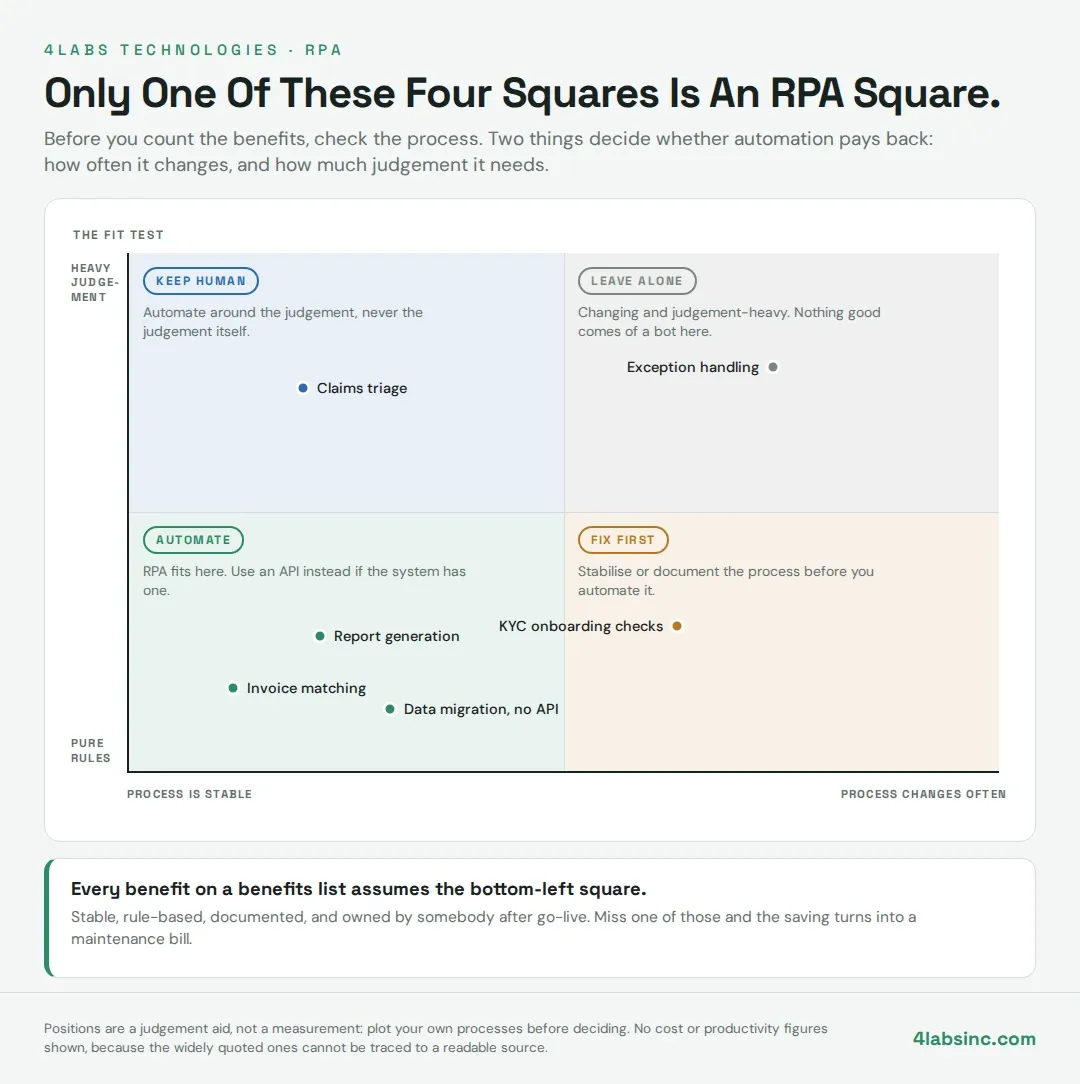
Every robotic process automation benefit above depends on three things being true. Miss one and the benefit does not appear, which is the honest explanation for most disappointed automation programmes.
The process has to be stable, because a bot is a recording of a process as it was on the day you built it. A process that changes every quarter generates a maintenance bill instead of a saving.
You have to measure it before you automate it. If you do not know how long the process takes today, how many items run through it, and what the error rate is, you cannot tell afterwards whether anything improved. Measure first and automate second, because teams that skip this step end up arguing about whether the automation ROI was real.
Somebody has to own it afterwards. A bot is software in production, and it breaks when a vendor updates a screen, when a certificate expires or when a file format changes. Name the owner before you deploy, and budget for the maintenance, because the alternative is a bot that quietly stops working and a process that quietly reverts to manual.
None of that is a reason to avoid RPA implementation, it is the difference between a programme that pays back and one that gets cancelled in year two. Our guide to the challenges in digital transformation covers the programme-level version of the same problem.

Where RPA is the wrong answer

Pages about the benefits of RPA do not print this section, which is why it is the most useful part of this one.
A four-square.webp

Four processes to leave alone

A process that changes every quarter. You will spend more on rebuilding the bot than the bot saves, so fix the process or leave it manual.
A process with a real judgement step. If a human is weighing something that is not written down, automating the steps around the judgement is fine. Automating the judgement is a different technology and a different risk conversation.
A process nobody has documented. Automating an undocumented process usually means automating one person's version of it, including the shortcuts. Document it first, with process mining if you have it, then decide.
A broken process. Automation makes a bad process faster rather than better, so if the process has six approval steps that exist because of an incident in 2014, remove three of them before you automate the rest.

When an API beats a bot

If the system has a documented API and you can get access to it, use the API. It survives interface changes, it runs faster, and it does not need a licence per bot.
RPA earns its place when the API does not exist, when you cannot get access to it in a useful timeframe, or when the vendor charges more for integration than the automation is worth. That is a real and common situation, and it is why RPA still sells as the pragmatic route to business process automation. But choosing a bot when an API was available is the most expensive mistake on this list, because you pay for it every time the screen changes.

What changed in the category, and why it matters to you

Three things changed in robotic process automation while the benefits lists stayed the same, and all three are checkable.

RPA became part of something bigger

Gartner's market for this software is now business orchestration and automation technologies, and its mandatory features include AI agent orchestration, governance, life cycle management and multiagent coordination, alongside long-running stateful process orchestration. Vendors in that market describe extending existing RPA and business process management investments rather than replacing them.
Read that carefully, because it is good news and bad news: RPA did not stop working and your existing bots are not obsolete. But the category is now defined by orchestrating work across systems and agents, which the market calls intelligent automation, rather than by recording clicks. A benefits list from 2019 describes one capability inside a much larger product.

Agent washing, and how to spot it

In a press release dated 25 June 2025, Gartner predicted that over 40 percent of agentic AI projects will be cancelled by the end of 2027. The stated reasons are escalating costs, unclear business value and inadequate risk controls. The same release describes agent washing, where vendors rebrand existing products, including AI assistants, RPA and chatbots, without genuine agentic capability. Gartner estimated that only around 130 of the thousands of agentic AI vendors were legitimate.
If you are being pitched an agent in 2026, ask one question: what does it do when the situation is not in the rules? A bot follows the rules or fails, while an agent plans, chooses and reports what it chose. If the answer is vague, you are buying RPA with a new label, which may be fine, as long as you pay RPA prices for it. Our comparison of RPA tools sets out what the major platforms actually do, and our look at how UiPath is revolutionising RPA covers one of them in detail.

When a bot falls under AI rules

Plain RPA that follows written rules is not an AI system, and the question only changes the moment a bot starts scoring, ranking or screening people.
Under the EU Digital Omnibus agreement reached on 6 May 2026 and confirmed by member states on 13 May 2026, the obligations for Annex III high-risk AI systems moved from 2 August 2026 to 2 December 2027. Annex I systems moved from 2 August 2027 to 2 August 2028. The Article 50 transparency obligations stay on the original schedule from 2 August 2026.
For an automation roadmap the practical point is simple, because rule-following bots are outside this. The AI step you are planning to add next year may not be, especially in recruitment, credit or access to services. Ask the question while the roadmap is still a document. This is not legal advice, and the position outside the EU differs, but the direction of travel is the same everywhere. Our guide to future trends in robotic process automation covers where the category is heading.

How to get the benefits, in five steps

Nothing in an RPA implementation is complicated, and skipping it is what turns a benefit into a disappointment.
Pick one process. Start every RPA implementation with one high-volume, rule-based, stable process that has a named business owner, not five, because the first automation is how your organisation learns what automation ROI really looks like.
Measure it first. Volume, cycle time, error rate and cost per item, which is where process mining tools earn their place if you have them. Two weeks of measurement before a line of code is the cheapest insurance in the programme.
Build for the exceptions. In business process automation the happy path is twenty percent of the work. What happens when the invoice has no purchase order, when the file is late, when the system is down. Decide who gets those and how they come back.
Name an owner and a review cadence. Somebody owns the bot the way they own an application, and looks at it monthly.
Budget for maintenance. A running bot needs care when screens, formats and rules change. Teams that budget for this keep their savings, and teams that do not lose them quietly over eighteen months.

Where to start with RPA

If you are reading a page about the benefits of RPA, you are probably building a case rather than buying an intelligent automation platform. Two useful next steps.
Test one process against the conditions. Take your best candidate and check it honestly: stable, measurable, documented, owned. If it passes all four it is a good first automation, and if it fails one, either fix that first or pick another process.
Get a second opinion before the business case goes up. The most expensive automation decisions are made before anybody writes code, and they are usually scope decisions. Our robotic process automation services team will look at a shortlist of processes and tell you which ones are worth automating, which need fixing first, and which would be better served by an integration. If the honest answer is that two of your five candidates are not worth it, we will say so.
If your constraint is people rather than tooling, our staff augmentation services cover the other route.
No obligation and no pitch deck.

Frequently asked questions

What are the main benefits of RPA?

Business process automation benefits fall into three groups. Work gets done faster, mainly because bots run outside office hours rather than because they type quickly. Work gets done consistently, with fewer errors and a complete audit log. And capacity flexes for peaks without hiring. Each benefit depends on the process being stable, measured before automation and owned afterwards.

What processes are best suited to RPA?

The best business process automation candidates are high volume, rule-based and stable, with digital inputs. Invoice processing, first-pass claims handling, report generation, data migration between systems that have no API, and routine account or user administration. Avoid processes that change every quarter, contain a real judgement step, or have never been documented.

How long does it take to see a return from RPA?

A single well-chosen RPA implementation usually pays back within months rather than years, but only if you measured it before automating. Automation ROI arrives sooner on processes that run daily than on processes that run at quarter end, because a bot saves time per run. Programmes that automate five processes at once take longer to show anything, which is why one at a time works better.

Is RPA being replaced by AI agents?

No, robotic process automation is being absorbed rather than replaced. Gartner's market is now business orchestration and automation technologies, with mandatory features around AI agent orchestration and multiagent coordination, and vendors describe extending existing RPA investments rather than replacing them. Existing bots keep working. The thing you buy next will be a larger intelligent automation platform with RPA inside it.

Does RPA fall under the EU AI Act?

Plain rule-following RPA is not an AI system, so it sits outside. Once a bot scores, ranks or screens people, the question changes. Under the Digital Omnibus agreement of 6 May 2026, obligations for Annex III high-risk systems move to 2 December 2027 and Annex I systems to 2 August 2028, while Article 50 transparency obligations remain from 2 August 2026. Take legal advice for your own use case.

What does RPA cost to maintain?

Robotic process automation costs more to maintain than most business cases assume. Bots break when vendors change screens, when file formats shift and when rules are updated, so plan for ongoing engineering time rather than a one-off build. The practical rule is to treat every bot as an application in production, with an owner, a monthly review and a budget line. Automations without an owner stop working quietly.


‹ PreviousNext ›