How the IT audit process actually runs
Four stages, and the first one decides everything that follows. If you want the operational detail on running these well, that sits on our IT audit best practices guide. What follows here is what each stage is for, and where each one tends to go wrong.
Scoping: deciding what is in and what is out
Scope is negotiated, and most people do not realise it is negotiable.
An audit cannot examine everything, so somebody decides what it looks at: which systems, which controls, which period, which locations, which business units. That decision determines what the audit can find, which means it also determines what it cannot find.
This cuts both ways. A scope drawn too narrowly produces a clean report about a small corner of the estate, and a clean report is what most people asked for, which is exactly the problem. A scope drawn too widely produces a shallow look at everything and a findings list too long to act on.
The useful question at scoping is not what should we audit. It is what would we most hate to be wrong about. Scope towards that.
The asset inventory problem
Scoping runs into the same obstacle in almost every organisation: nobody has a complete, current list of what exists.
The configuration database is out of date, and cloud accounts have resources nobody has looked at in a year. There are systems running in one business unit that central IT has never heard of. Somebody is paying for a service on a personal card.
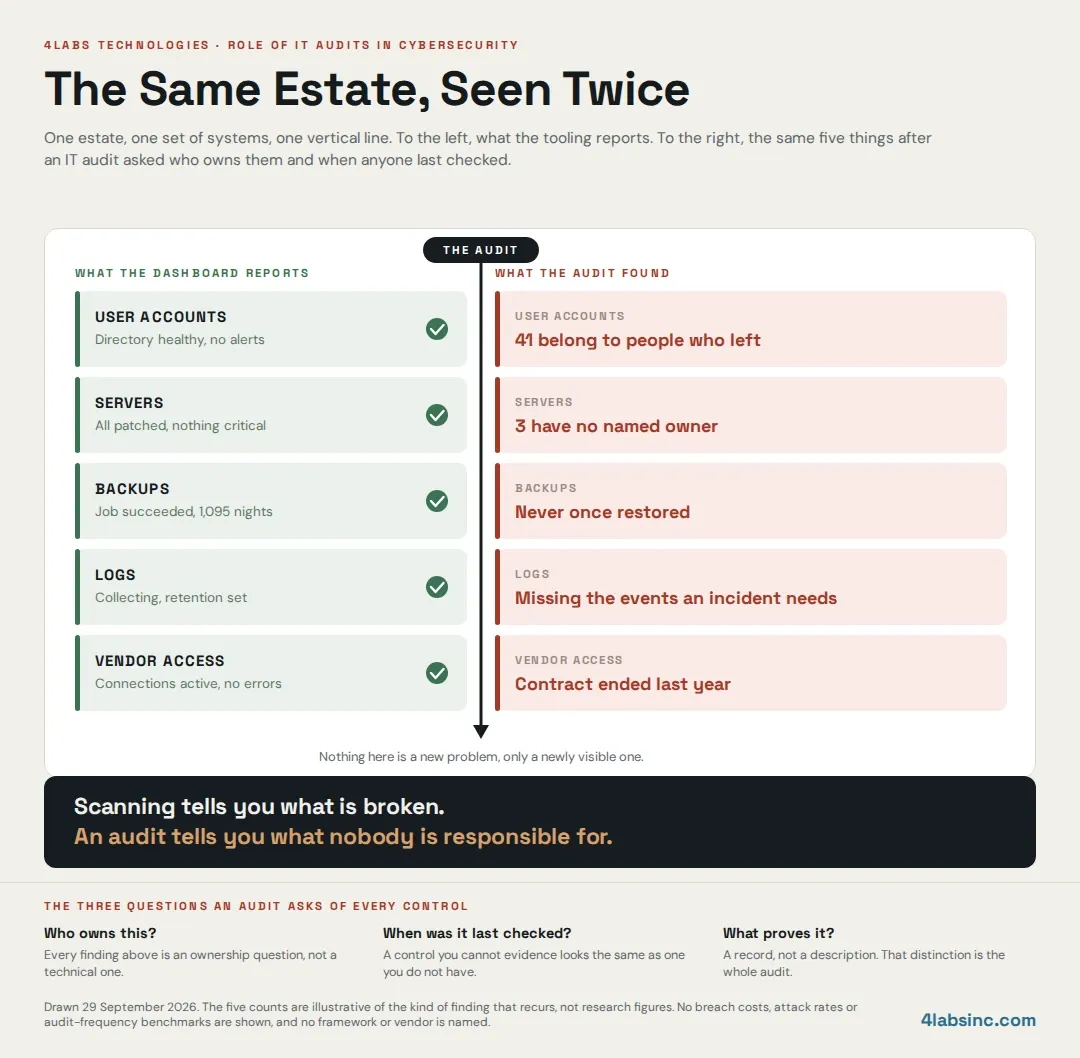
This is not a reason to delay the audit. The incomplete inventory is itself a finding, and usually a significant one, because every other control depends on knowing what you have. You cannot patch, monitor, back up or decommission a system you do not know about.
Start with what you know and let the audit surface the rest, because an audit that waits for a perfect inventory never starts.
Evidence: the request list and why it takes so long
The evidence request list is where audits consume the most internal time, and where most of the frustration lives.
The auditor asks for records, not descriptions. The access review for the last two quarters, signed off. The change tickets for a sample of production changes. The restore test report. The list of leavers and the corresponding account deactivations, with dates.
The reason this takes weeks is rarely that the controls do not work. It is that the evidence was never produced in a form anybody kept. The access review happened in a meeting, the change was discussed and approved on a call, and the restore worked but nobody wrote it down.
An auditor cannot accept any of that, and they are right not to. A control you cannot evidence is indistinguishable from a control you do not have, from the outside. That statement annoys people, and it stays true.
The organisations that find audits painless are the ones whose controls produce records as a by-product of running, rather than as a special effort at audit time. Getting there is mostly a matter of preparation, which we cover in detail on prepare for an IT audit.
Security controls assessment, and what sampling really proves
The auditor now tests the controls, and almost always by sampling.
They will not review every one of last year's changes. They will take twenty-five and check each one against the process. If all twenty-five hold, the control is assessed as effective. If three fail, the control is assessed as not effective, and the finding is about the control rather than about those three changes.
This is worth understanding properly, because it shapes what a clean report means.
A passed sample says the control worked on the instances examined. It does not say the control always works. It says that if the control were broadly broken, a sample of that size would probably have caught it. That is a real and useful statement, and it is weaker than we are fine.
It also means failures are more informative than passes. Three failures out of twenty-five is not a small problem affecting three changes. It is evidence of a process that does not hold, and the correct response is to fix the process rather than the three tickets.
The report, and how findings get rated
The report lists findings, each with a rating, usually on a three or four point scale from critical to low.
The ratings are judgements, not measurements, and they are the part of the report most worth arguing with. An auditor rates against likelihood and impact as they understand your business, and they do not know your business as well as you do. A finding rated medium may be existential for you. One rated high may concern a system being decommissioned next quarter.
So read the ratings as a starting position. Where you disagree, say so during the report review, before the report is final, and record the reasoning. We accept this and here is why is a legitimate management response. We ignored it is not, and six months later those two look identical unless somebody wrote the reasoning down.