Which Microsoft Dynamics product you actually need
Dynamics 365 is a family of applications, not one product. The ERP decision is between Dynamics 365 Business Central and Dynamics 365 Finance and Operations, and they suit organisations of very different shapes.
Both are cloud ERP products and they are not interchangeable. Getting this wrong is expensive in both directions. A business that would have been live in five months on Business Central spends eighteen on Finance and Operations. A business that needed Finance and Operations outgrows Business Central in year two and pays for the move twice.
Dynamics 365 Business Central
Built for small and mid-sized organisations. Faster to implement, lighter to run, and far more capable than enterprise buyers assume.
It handles financials, sales, purchasing, inventory, projects and light manufacturing well. For a single-country business with a handful of legal entities and steady transaction volumes, it is often the right answer even at a few hundred employees.
Where it runs out: complex multi-entity structures with heavy intercompany posting, multi-country tax and consolidation, very high transaction volumes, and deep production planning across sites.
Dynamics 365 Finance and Operations
The enterprise ERP system. Multi-company, multi-currency, multi-country, with deep manufacturing, supply chain and warehouse capability.
It does things Business Central cannot, and it asks for more in return: a longer ERP implementation, a heavier operating model, more environments to manage, and different licensing. The capability is real and so is the overhead.
How enterprises get this wrong
Two patterns, both common.
A partner leads with Business Central because it demos well and quotes low. The gap surfaces in month nine, when intercompany consolidation turns out to need workarounds nobody costed.
Or the organisation assumes that enterprise means Finance and Operations, buys the heavier product on reputation, and runs an eighteen-month programme for requirements the lighter product covered.
The four dimensions that decide it
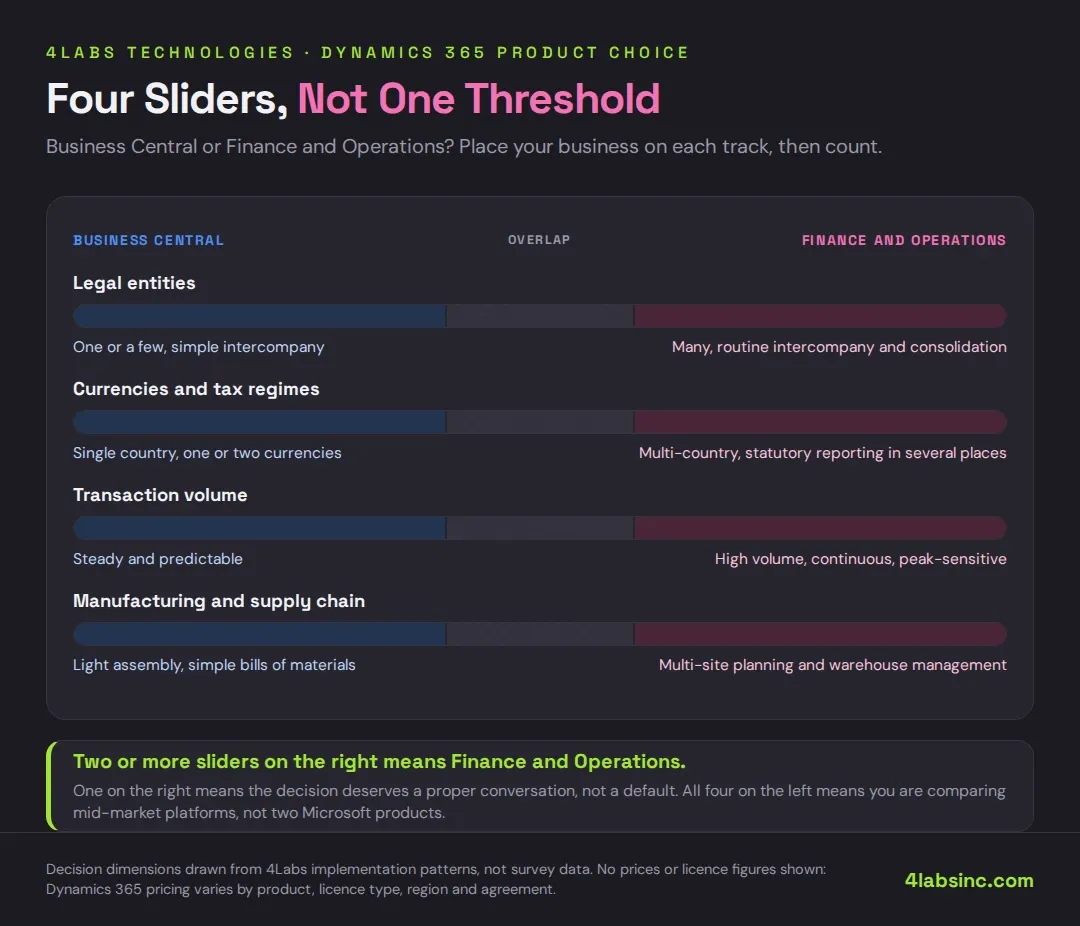
It is not one threshold. Score your own business on each.
|
Dimension
|
Business Central territory
|
Finance and Operations territory
|
|---|
|
Legal entities
|
One to a few, simple intercompany
|
Many, with routine intercompany posting and consolidation
|
|
Currencies and tax regimes
|
Single country, one or two currencies
|
Multi-country, multi-regime, statutory reporting in several places
|
|
Transaction volume
|
Steady, predictable
|
High volume, continuous, peak-sensitive
|
|
Manufacturing and supply chain
|
Light assembly, simple bills of materials
|
Multi-site production planning, warehouse management, complex routing
|
Two or more rows sitting firmly on the right means Finance and Operations. One row means the decision deserves a proper conversation rather than a default.
If you land on the left of all four, the honest comparison is not between two Microsoft products at all. It is between Business Central and the other mid-market platforms, and our guide to Odoo for smaller organisations covers one of them.
Not sure which side you are on? Working through entity structure and volumes takes an hour and settles it, and it is worth doing before you see a demo rather than after.