Logo
Logo
ServicesIndustriesCase StudiesBlogsCareersLet's Connect
blue-white-icon
black-image
Logo
ServicesIndustriesCase StudiesBlogsCareersLet's Connect
burger-icon
hamburger
How ERP Systems Improve Financial Management and Reporting
Blogs/ERP for Financial Management

How ERP Systems Improve Financial Management and Reporting

January 10, 2026
Share Now

Table of Contents

  1. 1. How ERP Systems Improve
  2. 2. What is ERP financial management
  3. 3. Why does the month-end
  4. 4. How ERP systems improve financial reporting
  5. 5. What an ERP system does not fix
  6. 6. What changes for a multi-entity group
  7. 7. What good looks like, in numbers
  8. 8. When a finance team is ready for this
  9. 9. How 4Labs Technologies approaches
  10. 10. Frequently asked questions
  11. 11. The close is a data problem

Half of finance teams still take six or more days to close. Here is what an ERP system changes, and what it does not.
Key takeaways

  • Half of finance teams take six or more business days to close the books. Fewer than one in five close within three.
  • The delays are data delays. Spreadsheets, systems that do not talk to each other, and waiting on other departments account for most of them.
  • ERP financial management and reporting removes the reconciliation and rekeying. It does not remove the waiting.
  • Multi-entity groups get the largest gain, because consolidation moves from a spreadsheet exercise to a system run.
  • Baseline your days-to-close, manual journal count and reconciliation hours before you start. Without those numbers you cannot prove the improvement.
    Ask a group financial controller how long the close takes and you get a number they are not proud of. Eight days. Eleven. Fourteen in the quarters with something unusual in them.They are not unusual. In a recent benchmark of finance professionals, half of teams took six or more business days to close the books, and fewer than one in five finished within three. The reasons given were not accounting reasons. They were data reasons: spreadsheets, systems that do not talk to each other, and waiting on other departments.That is the case for ERP financial management and reporting, and it is also the limit of it. ERP financial reporting changes how the numbers reach you. It is not a faster version of the same work. This guide covers where the days actually go, the seven mechanisms an ERP system uses to take them back, and the three blockers it leaves exactly where they are.

Stay Ahead With 4Labs

Get expert insights, security briefings, and the latest innovations in your inbox.

  • Afghanistan+93
  • Albania+355
  • Algeria+213
  • Andorra+376
  • Angola+244
  • Antigua and Barbuda+1268
  • Argentina+54
  • Armenia+374
  • Aruba+297
  • Australia+61
  • Austria+43
  • Azerbaijan+994
  • Bahamas+1242
  • Bahrain+973
  • Bangladesh+880
  • Barbados+1246
  • Belarus+375
  • Belgium+32
  • Belize+501
  • Benin+229
  • Bhutan+975
  • Bolivia+591
  • Bosnia and Herzegovina+387
  • Botswana+267
  • Brazil+55
  • British Indian Ocean Territory+246
  • Brunei+673
  • Bulgaria+359
  • Burkina Faso+226
  • Burundi+257
  • Cambodia+855
  • Cameroon+237
  • Canada+1
  • Cape Verde+238
  • Caribbean Netherlands+599
  • Cayman Islands+1
  • Central African Republic+236
  • Chad+235
  • Chile+56
  • China+86
  • Colombia+57
  • Comoros+269
  • Congo+243
  • Congo+242
  • Costa Rica+506
  • Côte d'Ivoire+225
  • Croatia+385
  • Cuba+53
  • Curaçao+599
  • Cyprus+357
  • Czech Republic+420
  • Denmark+45
  • Djibouti+253
  • Dominica+1767
  • Dominican Republic+1
  • Ecuador+593
  • Egypt+20
  • El Salvador+503
  • Equatorial Guinea+240
  • Eritrea+291
  • Estonia+372
  • Ethiopia+251
  • Faroe Islands+298
  • Fiji+679
  • Finland+358
  • France+33
  • French Guiana+594
  • French Polynesia+689
  • Gabon+241
  • Gambia+220
  • Georgia+995
  • Germany+49
  • Ghana+233
  • Gibraltar+350
  • Greece+30
  • Greenland+299
  • Grenada+1473
  • Guadeloupe+590
  • Guam+1671
  • Guatemala+502
  • Guinea+224
  • Guinea-Bissau+245
  • Guyana+592
  • Haiti+509
  • Honduras+504
  • Hong Kong+852
  • Hungary+36
  • Iceland+354
  • India+91
  • Indonesia+62
  • Iran+98
  • Iraq+964
  • Ireland+353
  • Israel+972
  • Italy+39
  • Jamaica+1876
  • Japan+81
  • Jordan+962
  • Kazakhstan+7
  • Kenya+254
  • Kiribati+686
  • Kosovo+383
  • Kuwait+965
  • Kyrgyzstan+996
  • Laos+856
  • Latvia+371
  • Lebanon+961
  • Lesotho+266
  • Liberia+231
  • Libya+218
  • Liechtenstein+423
  • Lithuania+370
  • Luxembourg+352
  • Macau+853
  • Macedonia+389
  • Madagascar+261
  • Malawi+265
  • Malaysia+60
  • Maldives+960
  • Mali+223
  • Malta+356
  • Marshall Islands+692
  • Martinique+596
  • Mauritania+222
  • Mauritius+230
  • Mayotte+262
  • Mexico+52
  • Micronesia+691
  • Moldova+373
  • Monaco+377
  • Mongolia+976
  • Montenegro+382
  • Morocco+212
  • Mozambique+258
  • Myanmar+95
  • Namibia+264
  • Nauru+674
  • Nepal+977
  • Netherlands+31
  • New Caledonia+687
  • New Zealand+64
  • Nicaragua+505
  • Niger+227
  • Nigeria+234
  • North Korea+850
  • Norway+47
  • Oman+968
  • Pakistan+92
  • Palau+680
  • Palestine+970
  • Panama+507
  • Papua New Guinea+675
  • Paraguay+595
  • Peru+51
  • Philippines+63
  • Poland+48
  • Portugal+351
  • Puerto Rico+1
  • Qatar+974
  • Réunion+262
  • Romania+40
  • Russia+7
  • Rwanda+250
  • Saint Kitts and Nevis+1869
  • Saint Lucia+1758
  • Saint Pierre & Miquelon+508
  • Saint Vincent and the Grenadines+1784
  • Samoa+685
  • San Marino+378
  • São Tomé and Príncipe+239
  • Saudi Arabia+966
  • Senegal+221
  • Serbia+381
  • Seychelles+248
  • Sierra Leone+232
  • Singapore+65
  • Slovakia+421
  • Slovenia+386
  • Solomon Islands+677
  • Somalia+252
  • South Africa+27
  • South Korea+82
  • South Sudan+211
  • Spain+34
  • Sri Lanka+94
  • Sudan+249
  • Suriname+597
  • Swaziland+268
  • Sweden+46
  • Switzerland+41
  • Syria+963
  • Taiwan+886
  • Tajikistan+992
  • Tanzania+255
  • Thailand+66
  • Timor-Leste+670
  • Togo+228
  • Tonga+676
  • Trinidad and Tobago+1868
  • Tunisia+216
  • Turkey+90
  • Turkmenistan+993
  • Tuvalu+688
  • Uganda+256
  • Ukraine+380
  • United Arab Emirates+971
  • United Kingdom+44
  • United States+1
  • Uruguay+598
  • Uzbekistan+998
  • Vanuatu+678
  • Vatican City+39
  • Venezuela+58
  • Vietnam+84
  • Wallis & Futuna+681
  • Yemen+967
  • Zambia+260
  • Zimbabwe+263
Our Services
Digital Marketing
Staff Augmentation
IT Infrastructure
ERP Solutions
Software Development
Web & App Development
Industries
Cryptocurrency and Blockchain
Banking, Financial Services, and Insurance (BFSI)
Lending and FinTech
Oil and Gas
Energy and Utilities
Automotive and Manufacturing
Agriculture
Real Estate
E-commerce and Retail
Case Studies
Financial Services Test Automation
AI-Driven Customer Risk Profiling
Elevating Mobile Performance
Jewelry Client Transformation
AI Underwriting Revolution
Advanced Cybersecurity Solutions
Eyewear Retailer Transformation
Revolutionizing Manufacturing Operations
Offshore Development Excellence
Company

About Us

Careers

Let's Connect

Business Referral

Engagement Model

Partnership Programs

Resources

Blogs

footer1-iconfooter2-iconiso_iconiso_icon2

4labsicon

Copyright © 2026 4Labs Technologies. All Rights Reserved.

Privacy Policy

Terms & Conditions

Accessibility

fb-icon
twitter-icon
instagram-icon
linkedin-icon


What is ERP financial management, and what does it cover?

ERP financial management is the finance side of an ERP system, short for enterprise resource planning: the general ledger, payables, receivables, fixed assets, cash management, consolidation and reporting, all running on the same database as the operational transactions that generate them. Finance stops receiving data and starts reading it directly. The general ledger sits at the centre of it, and every other module posts into that one ledger.
That last sentence is the whole distinction, and it is the one vendor pages blur.
An accounting package records what finance is told. Someone exports from the warehouse system, someone else keys it into the ledger, and the ledger is then a description of the operation written after the fact. An ERP system removes the retelling. The goods receipt that happens in the warehouse posts the accrual. The sales order that ships creates the invoice. Finance is not a downstream department reconciling other people's exports; it reads the same records everyone else writes.
The modules an enterprise finance function touches directly:

Module What it holds Why the close depends on it
General ledger Chart of accounts, journals, periods The single book everything posts to
Accounts payable Supplier invoices, matching, payment runs Accruals and cut-off accuracy
Accounts receivable Customer invoices, collections, credit Revenue recognition and cash position
Fixed assets Register, depreciation, disposals Monthly depreciation without a side spreadsheet
Cash management Bank feeds, reconciliation Usually the single largest close task
Consolidation Entities, currencies, intercompany Group reporting without a spreadsheet model
Reporting Statutory and management output The pack, built from live data

None of that is exotic. What matters is that they share one set of records, which is why the benefits of implementing an ERP system that finance cares about all trace back to the same architectural decision. Every financial reporting gain described below depends on it.

Why does the month-end close take so long?

Because the numbers arrive in pieces, from systems that were never asked to agree with each other.
A benchmark study of 100 finance professionals, at companies from 51 to more than 10,000 employees across SaaS, healthcare and manufacturing, put numbers on it. The sample is small, so treat the figures as directional rather than definitive. They still match what we see in the field.

How long the close takes

Days to close Share of teams
1 to 3 business days 18%
4 to 5 business days 32%
6 or more business days 50%

Half the profession is spending more than a working week producing numbers that describe a month already gone.

What the teams blame

Blocker Share citing it
Dependency on other departments or regions 56%
Managing everything in spreadsheets 50%
Legacy systems that do not integrate 40%
High transaction complexity 39%
Understaffing and capacity gaps 37%

Read that list again with an ERP system in mind. Two of the top three are squarely data problems. The third is a calendar problem wearing a data problem's clothes: departments submit late partly because submitting means assembling something by hand.
Two more figures worth carrying into the next section. 94% of teams still use Excel somewhere in the close. And cash reconciliation alone consumes 20 to 50 hours a month, with most teams pulling from three to five separate systems to do it.
That is where the days go. Not into judgement, not into review, not into the parts of accounting that require an accountant. Into fetching, matching and retyping. An ERP system cannot remove every one of those blockers, but it removes the largest category of them.

How ERP systems improve financial reporting: seven mechanisms

Here is how an ERP system improves financial reporting in practice. Each mechanism names the blocker it removes. That matters, because a mechanism with no blocker attached is a feature, and features do not shorten a close.

1. One ledger, so reconciliation shrinks rather than speeds up

Removes: the 40% blocker, legacy systems that do not integrate.
Most reconciliation exists because two systems hold versions of the same transaction and someone has to prove they agree. When the sale, the despatch and the invoice are one record rather than three, that proof is not needed. The work does not get automated. It stops existing.
This is the difference worth pressing a vendor on. Bank reconciliation still happens, because the bank is genuinely a separate party. Intersystem reconciliation should not, and if a proposed design still requires it, the integration is incomplete.

2. Transactions post as they happen, so the close starts from a current position

Removes: the first three days of most closes.
In a fragmented estate, day one of the close is finding out where things stand. Exports are pulled, subsystems are cut off, balances are assembled. Only then does accounting begin.
When goods receipts, shipments, invoices and payments post continuously, the general ledger is broadly right at midnight on the last day. The close becomes accruals, judgement and review rather than assembly.

3. Intercompany and consolidation run inside the system

Removes: the spreadsheet consolidation model, and part of the 56% dependency blocker.
For a group, this is usually the single largest gain. Entities post in their own currency to a shared chart of accounts. Intercompany balances match at source. Eliminations and translation run as a process rather than as a workbook one person maintains and everyone fears.
It also removes a specific risk most groups carry quietly: the consolidation model that only one person fully understands.
### 4. Approval workflows replace the chasing
Removes:
part of the 56% dependency on other departments.
Approvals routed and tracked in the ERP system give you two things you cannot get from email. The request reaches the right person automatically, and you can see exactly who is holding the close up, with timestamps.
This one comes with a caveat that belongs in the honest section below. Workflow makes the waiting visible and measurable. It does not make anyone answer faster.

5. Reports read live data, so the pack stops being rebuilt monthly

Removes: part of the 50% spreadsheet blocker.
Most management packs are assembled by hand every period: export, paste, refresh, check, format. When reports query the ledger directly, the pack is defined once and run whenever anyone wants it. This is what real-time financial reporting means in practice, and it is less dramatic and more useful than the phrase suggests. Board slides stop being an artefact of one analyst's weekend.
The real gain is not speed. It is that the number on slide four and the number in the ledger are the same number, because they came from the same query.

6. The audit trail is a by-product, not a project

Removes: most of the audit preparation scramble.
Every posting carries the user, the timestamp, the source document and the approval that authorised it. Segregation of duties is configured in roles rather than asserted in a policy document. When an auditor asks to walk a transaction from source to statement, you click rather than search. Audit-ready financial reporting stops being an annual project.
For regulated groups this also changes what is provable. Evidence collected as a matter of course is stronger than evidence assembled after the request arrives.

7. Forecasting gets a foundation worth trusting

Removes: the argument about whose actuals are right.
Forecasting is only as good as the actuals underneath it. When those come from one ledger, with consistent account mapping across entities, the variance analysis is about the business rather than about data quality. Rolling forecasts become feasible because refreshing them is not a rebuild.
This is also the base that automation and AI features in ERP platforms need. Anomaly detection against clean, consistent ledger data is useful. The same feature pointed at three inconsistent sources produces noise. Month-end close automation pays off after the general ledger is consolidated, not before.
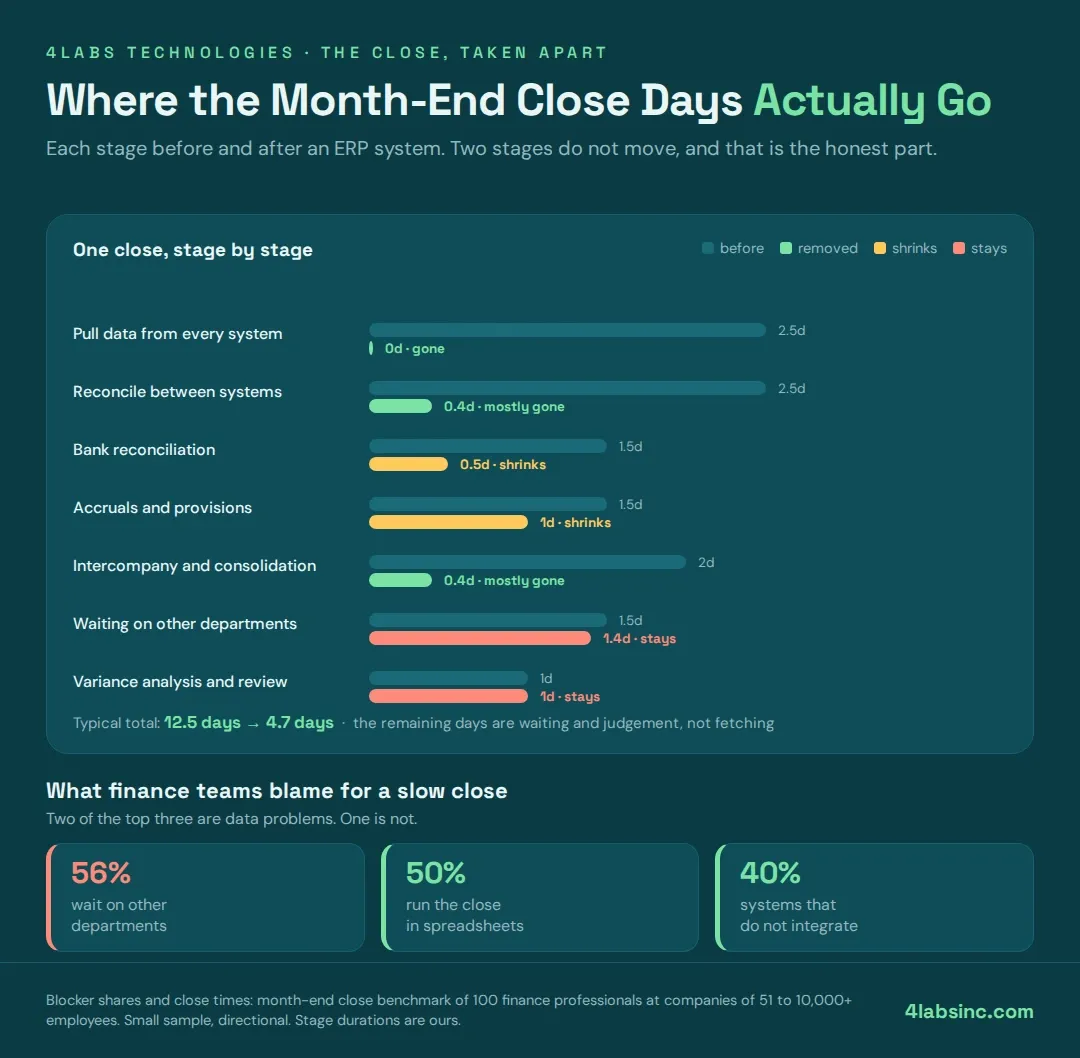
Month-end.webp

The chart above breaks a typical close into stages and marks which ones an ERP system removes, shrinks, or leaves untouched.


What an ERP system does not fix

Go back to the blocker list. An ERP system deals with some of it and leaves the rest standing, and knowing which is which is the difference between a business case that survives and one that gets quietly resented.
Dependency on other departments: 56%, mostly still there. If the German subsidiary submits on day four because the person doing it has three other jobs, a new ledger will not move that date. Workflow makes the delay visible and attributable. It does not shorten it. That is a calendar, staffing and accountability problem, and it usually needs a close timetable with named owners rather than software.
Spreadsheets: 94%, reduced but not eliminated. Excel comes back wherever reporting is not built out properly, and it should stay for genuine modelling and scenario work. What should disappear is the spreadsheet that exists because two systems do not agree. If people are still rekeying after go-live, the reports were not finished.
Understaffing: 37%, untouched. An ERP system gives hours back to a finance function. It does not give people back. A team already short two heads will feel the implementation as extra work first, and the relief only comes after go-live.
Bad data: worse before better. Migration exposes everything. Duplicate suppliers, customer records with three spellings, a chart of accounts that grew by accident over a decade. The ERP system will not clean it, and starting to clean it in month two of the project is what turns a nine-month implementation into a twelve-month one.
Transaction complexity: 39%, mostly structural. Complicated revenue arrangements and unusual group structures stay complicated. A good configuration handles them consistently. It does not simplify them.
We say this to every finance client during the first workshop: an ERP system removes the fetching and the matching. Everything that depends on another human deciding something stays exactly as fast as that human.

What changes for a multi-entity group

Single-entity companies gain hours. Groups gain a different kind of thing, and it is worth separating. ERP financial reporting for a group is mostly a consolidation story.
Consolidation stops being a model. Most groups run consolidation in a workbook: trial balances pasted in, translation applied, eliminations booked by hand, a summary tab that feeds the pack. It works, it is fragile, and one person owns it. An ERP system replaces the workbook with a process. Inside an ERP system, entities post to a shared chart of accounts and the consolidation runs as a process with an audit trail.
Intercompany matches at source. Instead of chasing balances between subsidiaries at period end, matched intercompany postings are created as transactions happen. Disputes surface during the month rather than on day six.
Currency translation is applied, not calculated. Rates are held once, applied consistently, and the treatment of each account type is configured rather than remembered.
Statutory and management reporting come from one set of records. Local books satisfy local requirements while the group reads a consistent management view. The old pattern, where a subsidiary keeps local books and a separate group submission, is where reconciliation differences breed.
Shared service centres become possible. Once processing is standard across entities, payables or receivables can be centralised without every location keeping its own exceptions.
One caution. Consolidation only behaves this way if the chart of accounts is designed for the group before entities go live. Retrofitting a common account structure across twelve subsidiaries that have already migrated is expensive and slow. Our post on ERP for large enterprises covers the programme shape that avoids it, and cloud platforms make the multi-entity part easier than it used to be.

What good looks like, in numbers

Baseline these before you start. Not after, and not from memory. Unproven improvements get argued away in the first budget review after go-live. These are the financial reporting metrics worth tracking permanently, not only across the project.

Metric How to measure it Where you probably are Where to aim
Days to close Business days from period end to sign-off 6 or more for half of teams 3 to 5, then 1 to 3
Manual journals per period Count them, split standard from correcting Often in the hundreds Standard only, posted by template
Reconciliation hours Hours on cash reconciliation per month 20 to 50 across 3 to 5 systems Bank only, hours not days
Pack built by hand Share of report pages assembled manually Frequently most of it Under a quarter
Correcting entries after close Count per period Rarely tracked Falling each quarter
Audit preparation Days spent assembling evidence Weeks in many groups Days
Intercompany disputes Open items at period end Chased at close Matched during the month

Two notes on using this table.
Measure the same way each time. Days to close means business days to final sign-off, not to the first draft trial balance. Teams that move the definition record improvements they did not make.
Expect the dip. The first two or three closes after go-live are usually slower than the last one on the old system. People are learning, and edge cases surface. Judge the trend from the fourth close, not the first.

Know your numbers before you shop. Send us your current days-to-close, manual journal count and reconciliation hours. We will tell you which of them an ERP system moves, roughly how far, and which ones need a process change instead.

When a finance team is ready for this

ERP for finance teams is a large commitment, so the timing matters. Four signals it is time:

  • Finance spends more days assembling numbers than analysing them. The clearest one. If the team's month is mostly fetching, your systems are the constraint and an ERP system is the usual answer.
  • The group has more entities than the consolidation model can carry safely. When one workbook and one person stand between you and group reporting, the risk is already larger than the cost of fixing it.
  • An auditor, lender or acquirer has asked for evidence you had to assemble by hand. External scrutiny is where fragmented finance data becomes expensive rather than annoying.
  • You are adding entities, currencies or regulatory regimes. Building the structure before the complexity arrives costs a fraction of retrofitting it after.
    Two signals to fix something else first:
  • The chart of accounts is a mess and nobody owns it. Migrating it unchanged guarantees the same financial reporting problems in a more expensive ERP system. This is a two-month cleanup that pays for itself immediately.
  • The close is slow because of people, not systems. If submissions are late because the finance team is two heads short, an ERP implementation on top of that workload will hurt. Staff first.
    If the signals point the right way, the ERP platform question comes next, and our comparison of SAP, Odoo and Microsoft Dynamics covers it. Smaller finance teams should look at Odoo and similar all-in-one platforms before assuming they need enterprise-scale software.

How 4Labs Technologies approaches ERP finance implementations

We run ERP finance implementations in a fixed order, because the order is what decides whether the close actually shortens.
Chart of accounts first. Before any configuration, we agree the account structure the group needs for the next five years: dimensions, entities, cost centres, statutory versus management views. This is unglamorous and it is the single largest determinant of your reporting quality afterwards.
Then the close design. We map the current close day by day, name each task, and decide which ones disappear, which shrink, and which stay a process problem. That map becomes the target timetable, and it is what we measure against.
Then reporting. The pack is built before go-live, not after. Teams that defer financial reporting rebuild it in Excel for six months and never stop.
From there: configuration, data migration with cleansing, parallel run, and hypercare through the first three closes. We work across SAP, Odoo and Microsoft Dynamics, and deliver through ERP software development and the implementation practices that keep the programme on its timeline.

Book a finance process review. We map your close, your chart of accounts and your reporting pack before discussing any platform, then show you where the days actually go and which of them software can take back.

Frequently asked questions

How does an ERP system improve financial reporting?

It puts finance and operations on one database, so reports read live transactions rather than exports. That removes intersystem reconciliation, shortens the month-end close, keeps an audit trail automatically, and makes the management pack a saved query rather than a monthly rebuild. In short, it turns periodic reporting into real-time financial reporting.

Is ERP financial management the same as accounting software?

No. Accounting software records transactions after the fact, usually from data keyed in from elsewhere. ERP financial management runs the ledger on the same records as the operation, so goods receipts, shipments and invoices post directly. An ERP accounting system is the ledger inside a wider operational system rather than a standalone book. The difference shows up most at month-end.

How much faster is the month-end close after ERP?

It depends on where you start. Teams closing in six or more days often reach three to five, and well-run single-entity implementations reach one to three. The gain comes from removing reconciliation and assembly, so teams whose delays are caused by late submissions improve less.

Does an ERP system handle multi-entity consolidation?

Yes, and it is usually where groups get the most value. Entities post to a shared chart of accounts, intercompany matches at source, and currency translation and eliminations run as a process with an audit trail. It depends on designing the group account structure before entities go live.

Will we still need spreadsheets?

Yes, for modelling, scenarios and ad hoc analysis. What should disappear is the spreadsheet that exists because two systems disagree. If your team is still rekeying data between systems after go-live, the reporting layer was left unfinished.

How long does an ERP finance implementation take?

Nine months is the median across ERP projects of all sizes. A single-entity finance implementation on a cloud platform can run shorter. Multi-entity groups with several currencies and statutory regimes run longer, and the chart of accounts work should start before the clock does.

The close is a data problem before it is a software problem

Half of finance teams take six or more days to close, and when asked why, they describe spreadsheets, systems that do not integrate, and waiting on other people. Two of those three are what ERP financial management and reporting is for.
The third is not, and no platform will make it so. A close timetable with named owners does more for late submissions than any ledger.
So the question to take into an ERP vendor conversation is not which system has the better financial reporting module. It is this: of the days in our close, how many are spent fetching and matching, and how many are spent waiting for someone to decide something? Count them. The first number is what software buys back, and the second is yours to manage. The benefits of implementing an ERP system land for the teams that know the difference before they start.

‹ PreviousNext ›