How do you run an enterprise ERP transformation?
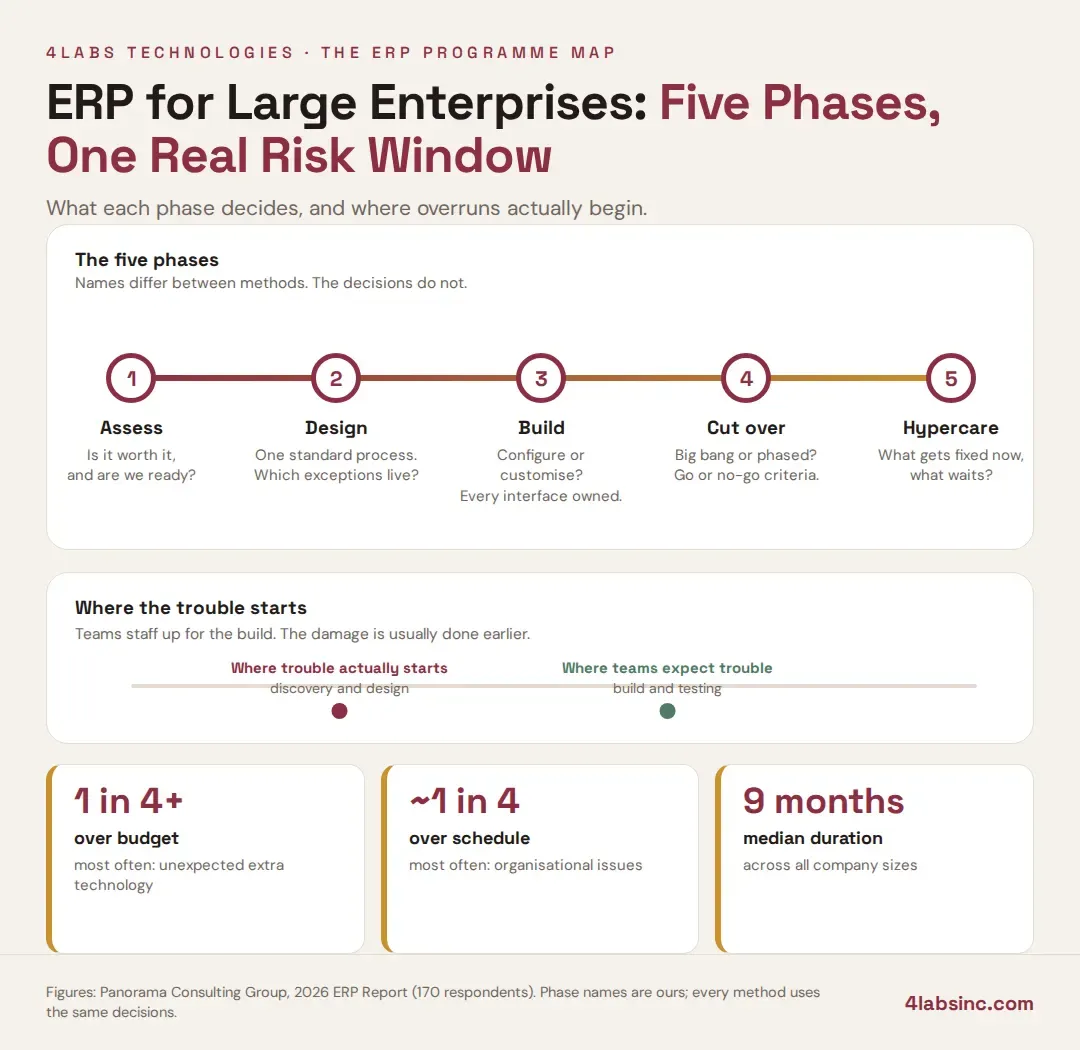
Five phases in an enterprise ERP transformation. The names vary between methodologies; the decisions do not.
Phase 1: Assessment and business case
You decide: what problem this solves, what it is worth, and whether the organisation can absorb it now.
You produce: a process inventory, a master data profile, an interface list, a benefits baseline you can measure against later, and a phased roadmap.
In the room: the executive owner, finance, the process owners for each major function, and someone who knows the integration estate.
The benefits baseline is the one people skip. If you do not record what the close takes today, you cannot prove it improved.
Phase 2: Design and data
You decide: the standard process, and which exceptions survive. Then the data rules: who owns each domain, what good looks like, and what gets archived rather than migrated.
You produce: the process design, the exception log, the data cleansing plan, and the security and authorisation model.
In the room: business process owners with authority, not delegates. This phase fails when the people attending cannot commit their function.
Phase 3: Build and integrate
You decide: configuration versus customisation, every time it comes up.
You produce: the configured system, the interfaces, the reports, and the migration routines. Interfaces get their own plan and owner each.
In the room: the delivery team, with process owners available for questions within a day. Slow answers are the quiet killer of this phase.
Phase 4: Test, train and cut over
You decide: big bang or phased, and the go or no-go criteria. Write the criteria before you are emotionally invested in the date.
You produce: test cycles including one full dress rehearsal with real volumes, trained users, and a cutover plan with hours and owners.
In the room: everyone. This is the phase where enterprise programmes discover which regional processes were never really tested.
Phase 5: Hypercare and adoption
You decide: when normal support takes over, and what gets fixed versus what gets deferred to enhancement.
You produce: a triaged issue list, adoption measures, and the first benefits review.
In the room: the same executive owner. Programmes that disband leadership at go-live lose the benefit case in the following quarter.
On resourcing: most large enterprises run this with a core internal team plus external specialists for the peaks. Our guide to staff augmentation for enterprises covers how that model works without handing over control of the programme.
Not sure whether you are ready to start? We run a short readiness review: master data quality, process variance across entities, integration surface, and whether there is a single accountable owner. Four findings, one session, no obligation.